
Robots, drones and edge AI machines sense, move and act in the real world. When software alone decides when a motor gets power or a radio switches on, an attacker who compromises that software controls the machine. Our Physical AI solution puts that decision in the TPM.
Secure GPIO uses the general-purpose I/O pins on a discrete TPM 2.0 from Infineon, Nuvoton, STMicroelectronics and other vendors. Each pin follows TPM policy, not software commands. Sensitive functions stay physically disabled by default and turn on only when the TPM’s conditions are met: a known boot state, a credentialed request, a signed approval, or once per boot before the pin locks.
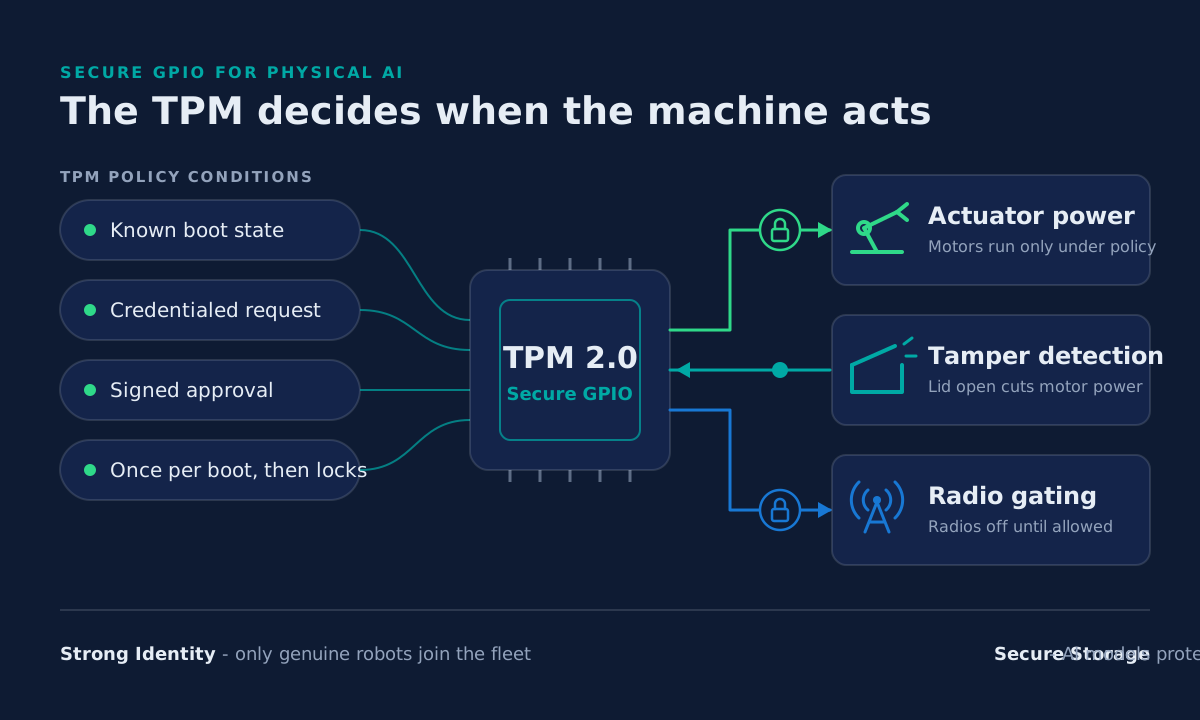
- Authorized actuator power. Motors and actuators receive power only under policy, so a compromised OS, a malicious app or a remote attacker cannot energize them.
- Tamper and lid-open detection. The TPM senses intrusion switches, lid contacts and tamper meshes directly, and it can cut motor power when an enclosure is opened.
- Radio and modem gating. Wi-Fi, cellular and other radios stay off until policy allows them, which limits a compromised device’s ability to call out or be reached.
Secure GPIO uses the TPM already on the board, so no separate secure microcontroller is needed. It behaves the same on SPI and I²C platforms. We write the TPM configuration and policies; you only decide which signals to protect.
The Physical AI solution pairs Secure GPIO with Strong Identity, so only genuine robots join a fleet, and with Secure Storage, which protects AI models and weights at rest. It targets humanoid robots, drones, industrial robots and cobots, and edge AI controllers.
Secure GPIO launched together with Strong Identity and Secure Storage; read the full announcement. It is available now on request. To see it on your own hardware, book a 45-minute expert-led demo with one of our TPM engineers.